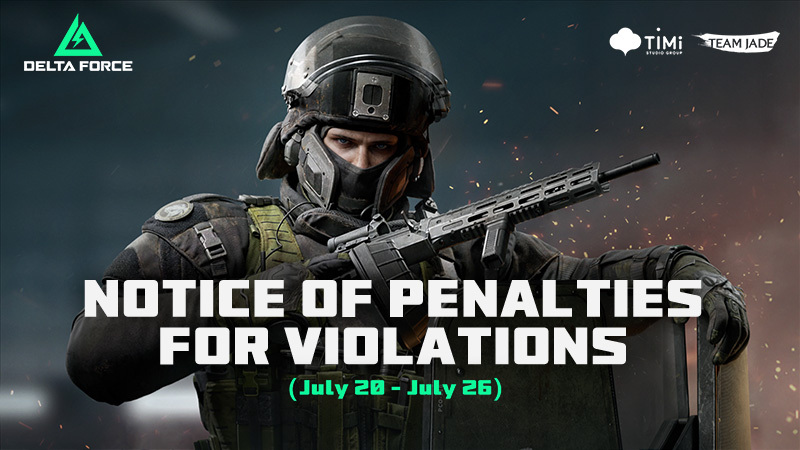
The G.T.I. Security team behind Delta Force has announced sweeping enforcement actions against cheaters and rule violators, demonstrating the game’s commitment to maintaining a fair competitive environment. In their latest security bulletin, the team revealed that thousands of accounts have been banned across PC, mobile, and console platforms, with significant measures taken to combat automated scripts, illegal software, and other forms of gameplay manipulation. The announcement comes as online gaming communities worldwide continue to grapple with the persistent challenge of cheating in competitive multiplayer games.
Key Points
- Players affected by cheaters receiving 30-day bans now qualify for compensation, previously limited to 10-year bans only
- PC enforcement issued 2,435 ten-year bans in one week, including 129 cases involving sophisticated DMA hardware cheats
- Mobile anti-cheat blocked 15,498 cheating attempts in real time during the same period
- The largest action targeted 274,433 automated script violations, resulting in 232,874 account bans and 41,559 benefit confiscations
- DMA devices, which read game memory via external hardware to evade detection, remain a priority enforcement target
The security team emphasized their zero-tolerance policy toward any form of cheating or terms of service violations. This includes the use of plug-ins, illegal third-party software, inappropriate behavior, and the malicious exploitation of bugs or glitches. When such activities are detected, investigations are launched immediately, potentially resulting in permanent account bans, IP-level restrictions, and public notifications both within the game and through external channels. The developers stressed that creating a safe and enjoyable environment for legitimate players remains their top priority.
Compensation Now Covers 30-Day Bans, Not Just Permanent Ones
In a significant policy update, the G.T.I. Security Team announced an expansion of their cheater kill compensation program. Previously, only players who were negatively affected by cheaters receiving 10-year bans were eligible for compensation. Under the new policy, players impacted by cheaters who receive 30-day bans will also qualify for compensation. This change reflects the development team’s acknowledgment that even shorter-term cheaters can significantly disrupt the gaming experience for legitimate players. When operators receive confirmation of a successful ban, compensation will be delivered via in-game mail within three business days. However, the team noted that if gear brought into a match was extracted by squadmates and returned to the player, duplicate compensation will not be issued.
This compensation system represents an increasingly common approach in the gaming industry, where developers recognize that punishing cheaters alone is insufficient—they must also make amends to the players whose experiences were ruined. Games like Activision’s Call of Duty franchise and Riot Games’ Valorant have implemented similar systems, acknowledging that the damage caused by cheaters extends beyond the immediate match to affect player trust and engagement with the game overall.
One Week's Numbers: 2,400+ PC Bans, 15,000 Mobile Cheats Blocked
| Platform | 10-Year Bans | Real-Time Blocks | Other Actions |
|---|---|---|---|
| PC | 2,435 (incl. 129 DMA) | 3,201 | 9,355 devices blocked 1 year; 1,917 forced offline |
| Mobile | 395 | 15,498 | 41 cheat tools targeted |
| Console | 6 | — | — |
| Economy/Bots | — | — | 232,874 bans; 41,559 confiscations |
The enforcement statistics from the week of July 20-26, 2026, paint a comprehensive picture of the ongoing battle against cheating. On PC, 2,435 users received 10-year bans, including 129 cases involving Direct Memory Access (DMA) devices, real-time interceptions, and account freezes. DMA cheats represent one of the most sophisticated forms of game manipulation, using external hardware to read game memory without detection by traditional anti-cheat software. Additionally, 9,355 devices were blocked for one year, 3,201 cheating attempts were stopped in real time before they could affect gameplay, and 1,917 players were forced offline for detected cheating. The team also issued 288 warnings to players caught teaming with known cheaters, and 43 cases resulted in bans with confiscation of unfairly obtained gains. Security measures were deployed against 35 different cheating tools.
Mobile platform enforcement saw 395 players receive 10-year bans, with an impressive 15,498 cheating attempts stopped in real time. Security actions targeted 41 different cheating tools designed for mobile devices. Console players, traditionally considered more protected due to closed hardware systems, were not immune either, with 6 violation penalty bans issued. These numbers underscore the reality that cheating affects gaming across all platforms, though the methods and scale vary significantly.
Quarter-Million Bot Accounts Swept in Economic Security Blitz
Perhaps the most striking figures came from enforcement actions targeting economic security violations. The security team reported addressing 274,433 instances of automated script usage in just one week. These violations included automated bulk registration of accounts, automated multi-client login systems, auto-farming or “run-through” scripts, auto-extract programs, and auto-sell supply bots. Of these cases, 41,559 resulted in the confiscation of ill-gotten benefits, while 232,874 account bans were issued. This massive operation highlights the significant threat that automated cheating poses to in-game economies, where artificial inflation of resources can destabilize virtual marketplaces and devalue the time investment of legitimate players.
The gaming industry has long struggled with the economic implications of cheating and botting. In games with robust trading systems and virtual economies, automated scripts can generate millions of units of in-game currency, which are then often sold for real money on gray market websites. This not only violates terms of service but can constitute fraud and money laundering in some jurisdictions. Major game publishers have increasingly partnered with law enforcement agencies to prosecute the most egregious offenders, recognizing that the problem extends far beyond simple gameplay disruption.
The G.T.I. Security Team concluded their announcement by encouraging players to actively report inappropriate behavior through official reporting channels and community platforms. This collaborative approach between developers and players has proven essential in identifying new cheating methods and maintaining healthy gaming environments. As online gaming continues to grow as both entertainment and competitive esport, the arms race between security teams and cheat developers shows no signs of slowing down, making such transparent communication and aggressive enforcement increasingly vital to the industry’s integrity.
Why the Bot Crackdown Matters Most
The headline figures on aimbots and wallhacks grab attention, but the 274,000 automated-script enforcements tell a bigger story. Bot farms generating currency and items threaten in-game economies more than any individual cheater. When illegitimate supply floods a marketplace, prices collapse, and hours of legitimate play lose their value. Confiscating gains—not just banning accounts—signals Delta Force is targeting the profit motive, not just the symptom.
Expanding compensation to 30-day bans is a notable shift. Previously, only victims of the most severe cheaters saw any redress. The new policy acknowledges that even a short-term cheater can ruin a session and erode trust. Expect other live-service shooters to watch whether this reduces player churn.
Hardware-based DMA cheats remain the toughest challenge. Because they operate outside the game’s memory space, traditional client-side anti-cheat struggles to detect them. The 129 DMA-related bans suggest G.T.I. is investing in behavioral detection and hardware fingerprinting, but the arms race is far from over.
Common Questions
How do I claim compensation after a cheater is banned in Delta Force?
You don’t need to file a claim. Once a ban is confirmed for someone who affected your match, compensation is automatically sent to your in-game mailbox within three business days. If squadmates already extracted and returned your gear, duplicate compensation won’t be issued.
What is a DMA cheat and why is it hard to detect?
DMA (Direct Memory Access) cheats use external hardware to read game data without touching the game’s process. Because they bypass software-level protections, traditional anti-cheat tools can’t see them directly, forcing developers to rely on behavioral analysis and hardware signatures.
Does Delta Force ban cheaters on console too?
Yes. Although console cheating is rarer due to closed hardware, the security team issued 6 violation bans on console during the reported week, confirming enforcement extends across PC, mobile, and console platforms.
Expert Opinion: The scale of Delta Force’s enforcement actions—particularly the quarter-million automated script violations addressed in a single week—indicates that game security has become an industrial-scale operation requiring significant investment in both technology and personnel. The expansion of compensation to include shorter ban periods suggests developers are shifting toward a more player-centric approach to anti-cheat policy. Moving forward, we can expect to see increased adoption of hardware-level detection methods and machine learning systems capable of identifying cheating behavior in real time, as traditional signature-based detection becomes increasingly inadequate against sophisticated DMA devices and constantly evolving cheat software.